
About the Journal
The Isabela State University Linker: Journal of Education, Social Sciences and Allied Health aims and scopes: Education encompasses various disciplines, including educational psychology, curriculum development, technology, teacher education, policy management, assessment, and evaluation. Social Sciences include sociology, psychology, anthropology, and economics. Allied Health involves epidemiology, biostatistics, disease prevention, and global health.
Current Issue
Vol. 3 No. 1 (2026): Isabela State University Linker: Journal of Education, Social Sciences, and Allied Health, January - June 2026
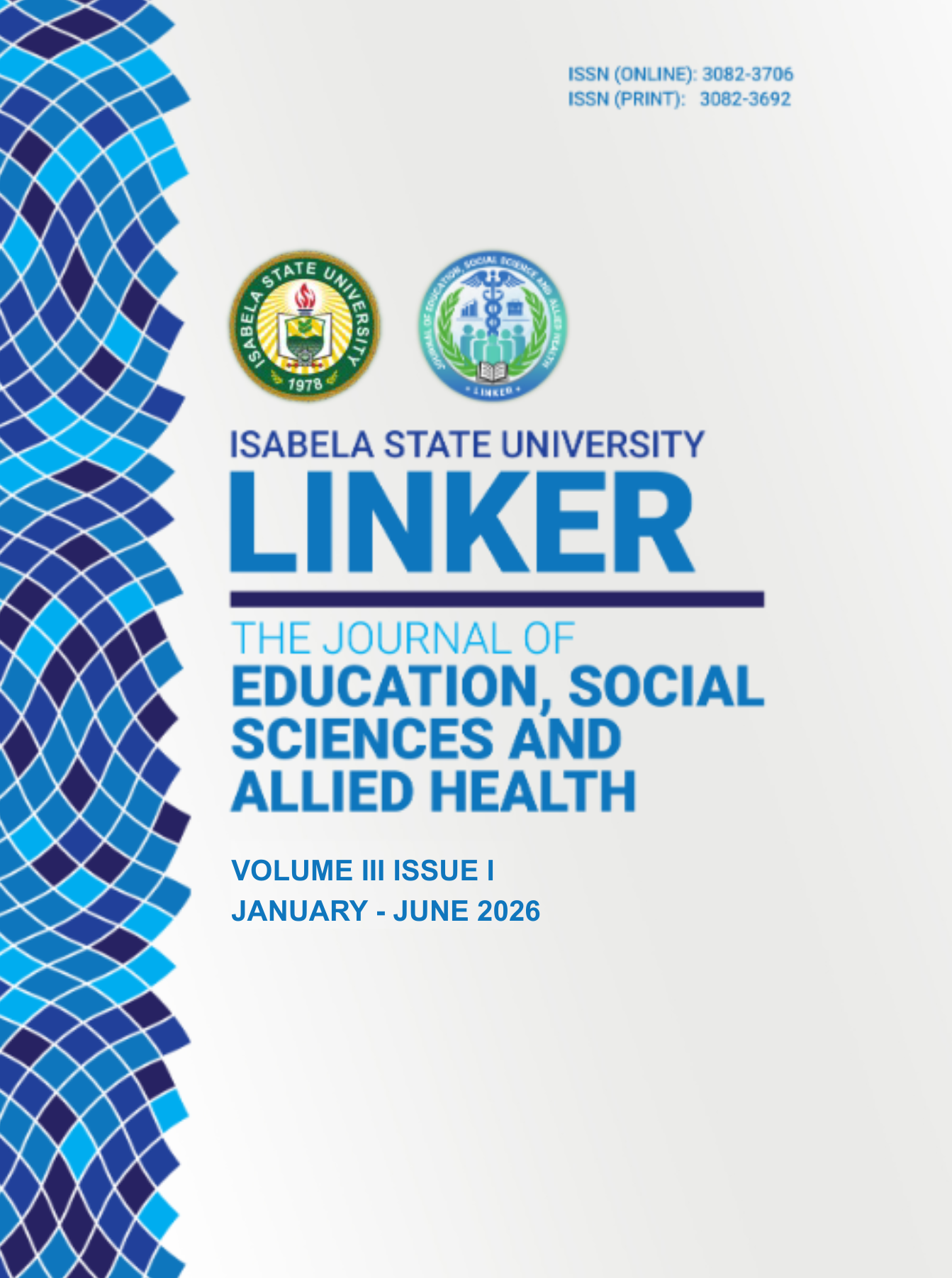
ISSN: 3082-3706 (Online)
ISSN: 3082-3692 (Print)
Publisher
ISU DESKTOP PUBLISHING
Isabela State University San Fabian, Echague, Isabela
Email: isulinkerjournal@isu.edu.ph For inquiries, please contact:
Dr. Jennelyn Lacar Raymundo, Editor-in-Chief,
Isabela State University Desktop Publishing
Contact No.: 0966-155-8608
Editor's Note
Welcome to Volume 3, Issue 1 of the Isabela State University Linkers: Journal of Education, Social Sciences, and Allied Health (JESSAH). Every time we put together a new issue, I am reminded that research is never just about data points or abstract theories. It is a deeply human effort to solve real-world problems, make our organizations run a little better, and understand how people adapt when things get tough. The papers in this volume reflect exactly that balance by combining sharp, publication-ready academic rigor with a genuine focus on practical, human experiences.
We begin this issue with a profound look at mental health and emotional recovery in higher education. Sevilla provides a moving narrative review on how university students navigate trauma. By mapping out how constructive reflection can lead to genuine post-traumatic growth, this work issues a powerful call for universities to adopt strength-based, trauma-informed spaces where students can safely recover and thrive. Following this, we look across our borders to see how structured classroom environments change student outcomes. Meng and Arce offer concrete quantitative proof from Hebei Province, China, demonstrating that pedagogical excellence and creative environments are not just idealistic concepts because they are the exact drivers that directly lift a student’s actual musical performance.
The volume then shifts toward systemic optimization and institutional support. Bacalso and Jain tackle the often-frustrating world of public sector procurement, designing an analytics-enabled framework that uses predictive demand modeling to make resource management transparent and reliable for government agencies. Turning back to the human challenges within the classroom, Guerzon and their colleagues utilize a phenomenological lens to unpack the heavy self-imposed pressure and daily adjustments felt by secondary school teachers assigned to subjects outside their specialization, reminding us why structured mentoring is so vital to prevent teacher burnout.
We close this issue with studies on creative innovation and long-term career outcomes. From Jilin Province, China, Zhao and Capacete share a fascinating look at vocal music educators balancing traditional ethnic heritage with cutting-edge tools like AI diagnostics and virtual reality to ensure arts education remains deeply personal, adaptive, and inclusive. Finally, returning to our local community, Devibar and Pascua present an honest MBA tracer study from right here at Isabela State University, showing that while our graduate instruction is highly valued, we need to intentionally invest more in IT and research competencies to truly prepare our graduates for a shifting corporate world.
On behalf of the Editorial Board, I want to say a heartfelt thank you to the authors who chose JESSAH as the home for their hard work, and to our peer reviewers who spent hours ensuring every paper meets our highest standards. I invite university leaders, policymakers, and fellow researchers to read these pages not just as academic literature, but as practical tools for building a more efficient, resilient, and inclusive future.
JANUARD D. DAGDAG, Ph.D.
Chief Editor- Linker- Journal of Education, Social Sciences, and Allied Health (JESSAH)
Published:
2026-06-30